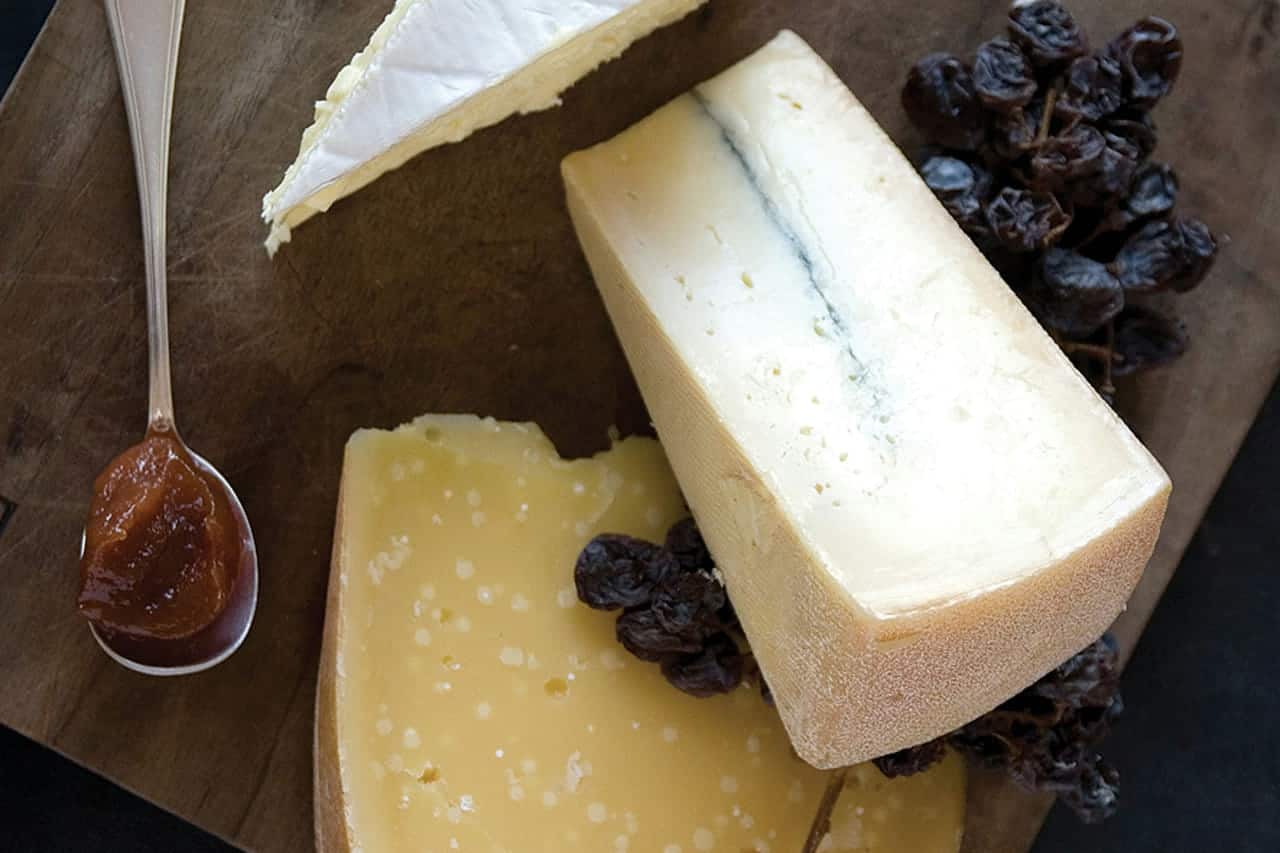
A cheese night is a dinner party with the cooking taken out. Done well, it feels generous and a little French: a long table, good bread, three bottles open and nobody in the kitchen. Done nervously, it is eleven cheeses on one board and a host who can’t remember which is which.
Our formula keeps it calm: three boards, each built around one family of cheese, each with the wine that loves it most. Serve them in order, mild to strong, the way a French cheese course runs. You will buy less, taste more, and walk up to the counter knowing exactly what to say.
The Alpine Board

Start with the mountain cheeses: firm, nutty and crowd-pleasing. Comté comes from the Jura and is aged for at least four months; ask for one aged a year or more, when it develops little crunchy crystals and a deep, brothy sweetness. Gruyère, from western Switzerland, is aged at least five months and tastes richer and earthier. Put both on the board and let people compare.
- On the board
- Comté, Gruyère (or Beaufort), walnuts, a sliced pear, a walnut or rye bread, and nothing else.
A white from the Alps: Savoie, or Swiss Chasselas
Crisp, light, mountain-bright whites grown in the same hills as the cheese. Their freshness cuts through the richness without hiding the nuttiness.
Everyday: a Savoie white made from Jacquère, such as an Apremont.
Better: a Chignin-Bergeron, the Savoie name for Roussanne: rounder and more aromatic.
Splurge: a Jura vin jaune, the nutty, sherry-like classic partner for an old Comté. Small pours only.
If you can’t find itAny crisp, unoaked dry white, such as an Alsace Pinot Blanc. For the cheese, any Alpine-style cheese aged a year.
The Soft Board

Then the soft, bloomy-rind cheeses: Brie, Camembert, Chaource or a triple-crème. In the US, look for the pasteurized versions; the raw-milk originals, Brie de Meaux and Camembert de Normandie, are aged for less than the 60 days American rules require for raw-milk cheese, so they aren’t sold here. Chaource, from the south of Champagne, is the one we would hunt for.
- On the board
- One whole small wheel (Camembert or Chaource) and one wedge of Brie or a triple-crème, a baguette, a few grapes.
Champagne, or a French Crémant
Bubbles and bright acidity lift a rich, buttery paste. Chaource and Champagne come from the same corner of France, which is why the match is a classic.
Everyday: a Crémant de Bourgogne, de Loire or d’Alsace, made in the same method as Champagne.
Better: a non-vintage brut Champagne.
Splurge: a blanc de blancs Champagne, all Chardonnay, for the most delicate cheeses.
If you can’t find itAny dry traditional-method sparkling wine. For the cheese, any soft cheese with a white, bloomy rind.
The Blue Board

Finish with blue, always last because it would flatten anything served after it. Roquefort is made from raw sheep’s milk and aged in the caves of the Combalou in the south of France: salty, creamy and bold. Fourme d’Ambert, a cow’s-milk blue from the Auvergne, is its gentle counterpart and the one to give the guest who says they don’t like blue cheese.
- On the board
- Roquefort, Fourme d’Ambert, fresh or dried figs, a little honey, a dark bread or plain crackers.
A sweet white from the southwest: Sauternes
Sweet against salty: honeyed wine with good acidity softens the bite of a blue. Roquefort with Sauternes is one of the great pairings.
Everyday: a Monbazillac, a sweet white from the Bergerac area, made in a similar style.
Better: a Sauternes or a Barsac in a half bottle; small pours go a long way.
Splurge: an older Sauternes from a well-known estate.
If you can’t find itAny late-harvest sweet white, or a tawny port. For the cheese, Bleu d’Auvergne or any creamy blue.
At the counter

- Before you order
Say how many, and how
Tell them: “Six people, cheese is the main event, three boards.” As a guide, plan about 2 oz per person for an apéritif and about 5 oz when cheese is the meal. For six, that is roughly 2 lb in all, or about 5 oz of each of six cheeses.
- At the counter
Ask to taste
A good counter will offer a sliver of anything you are unsure about. Taste the Comtés side by side and pick the one you like, not the oldest.
- At the counter
Have it cut to order
Ask for wedges cut from the wheel rather than pre-wrapped pieces, and for each one wrapped separately in cheese paper.
- The day before
Buy a day ahead, store it well
Keep each cheese in its paper (or waxed paper, never cling film straight on the rind) in the vegetable drawer of the fridge.
- One hour before
Bring it to room temperature
Take the boards out 30 to 60 minutes before guests arrive, still wrapped, and unwrap just before serving. Food-safety guidance is not to leave perishable food out for more than two hours.
- At the table
One knife per board
A separate knife for each board, and keep the blue apart so it doesn’t mark the others. Serve I, then II, then III.
- After
Wrap the leftovers
Rewrap each piece in fresh paper and eat within a few days, firm cheeses keep longest.
Who it’s for, and when
Anyone who would rather host than cook, small kitchens, and first-time hosts. It scales easily: one board and one bottle for two; all three for six to eight.
Friday nights from autumn to early spring, when rich cheese and a sweet wine feel right. In summer, serve the Alpine board alone with a chilled white outdoors.
Cheese night, in three moves
- Pick your three boards and write one short list: six cheeses, three bottles, bread, figs, pears, walnuts, honey.
- Shop the day before, with the list and the guest count in hand, and ask for everything cut and wrapped separately.
- An hour before, unwrap onto three boards, open the white and the bubbles, and chill the sweet wine. Done.
- Photo: Ines Iachelini / Unsplash
- Photo: Mike Houser / Unsplash
- Photo: Duskfall Crew / Unsplash
- Photo: Jez Timms / Unsplash
- Photo: Rebecca Orlov / Unsplash
Photographs used under the Unsplash License.


